Lead
1st c. AD
Empúries (L’Escala – Alt Empordà)
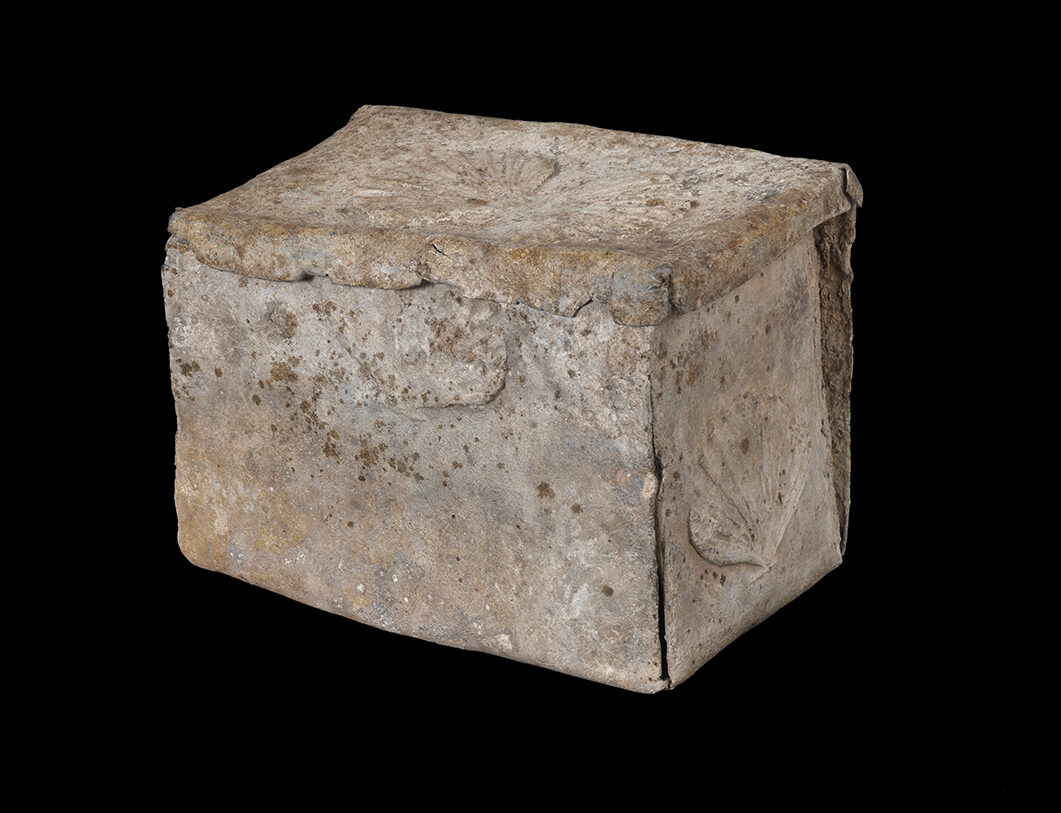
This cube-shaped lead cinerary urn with a lid (26 x 28 cm on each side and 20 cm tall) transports us to the world of the dead in 1st-century AD Empúries. It was brought to the museum as part of a batch of objects purchased from Pere Màrtir Pujol, a resident of L’Escala, in December 1900.
We know of at least seventeen urns of this type from the Empúries necropolises, ten of which are preserved in our museum. What makes this one different is the fact that on each vertical face there is a decoration stamped with a mould representing a shell. On the lid there are two, facing each other by the hinge. The shells are of the Pecten jacobaeus or pilgrim shell type.
We have not been able to identify any other urn with this decoration in our area. However, in England, at least since the 19th century, finds of Roman lead sarcophagi (although not urns) decorated with shells have been relatively frequent.
A stone sarcophagus was discovered in 1999 during the excavation of a large Roman cemetery in Spitalfields (London). Inside it was another sarcophagus made of lead, covered with a purple cloak and containing the body of a young woman. It was determined that the girl had come from Rome or its surroundings. Her head was resting on a pillow of laurel leaves; she had been embalmed with oils and perfumes from Arabia and the Mediterranean and wrapped in a silk fabric with gold thread. The lid of the sarcophagus had a stamped decoration consisting of a grid with 21 shells. It dates to the 4th century AD.
Three centuries apart; different social, economic and funerary environments, but the same representation of shells. What could it mean?