Attic black-figure pottery
5th c. BC
Empúries (L’Escala – Alt Empordà)
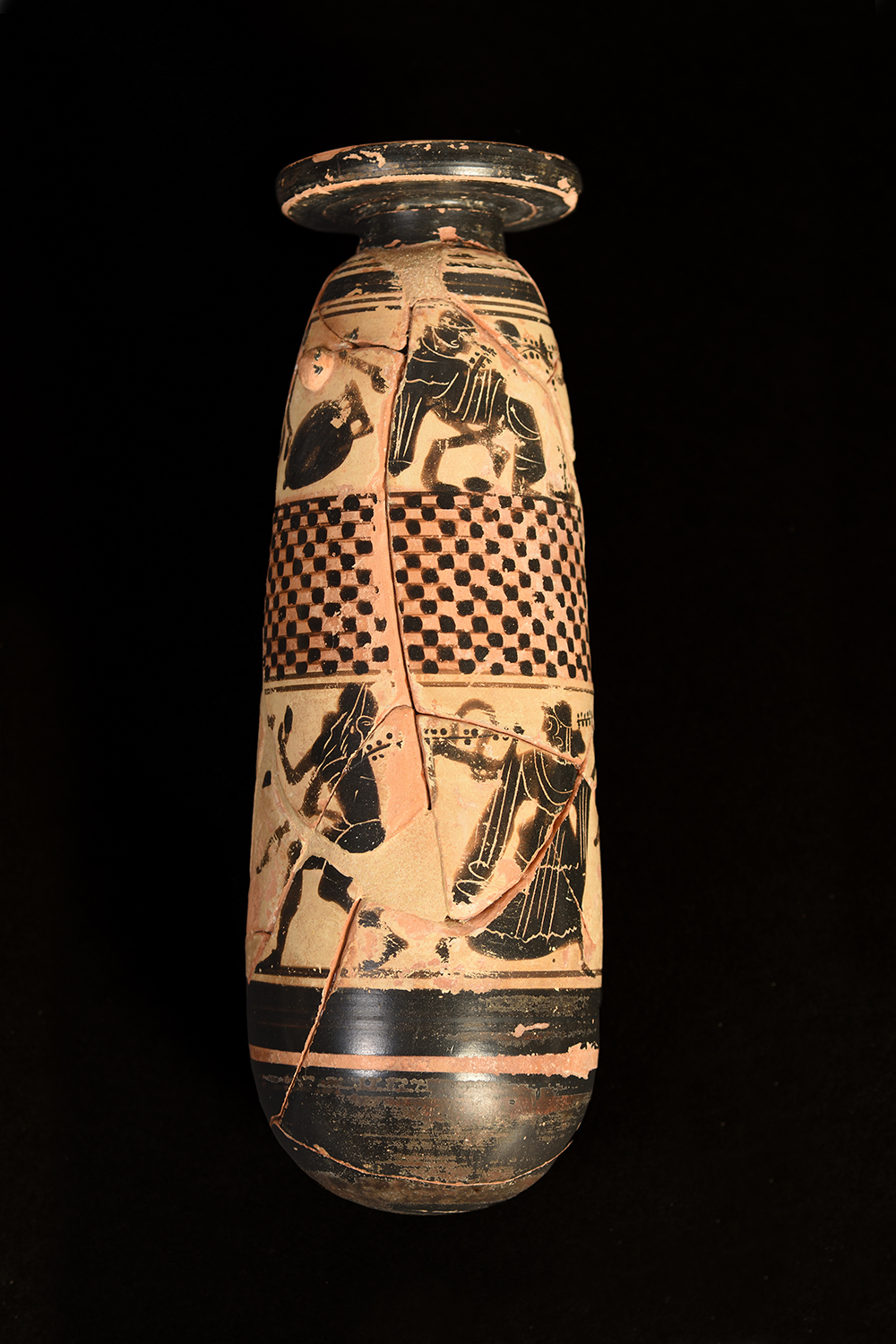
Alabaster receptacles from Corinth or Athens bore rich decorations that made them as attractive or even more so than their contents (unguents or perfumed oils intended for the deceased). Today we present such an object: an Attic alabaster container decorated with black figures. Attributed to the Painter of Haimon, who was active in the first half of the 5th century BC, it comes from one of the looted tombs in the Greek necropolis of Empúries.
With its short neck topped by the characteristic flat, mushroom-shaped lip, it maintains the pear-shaped appearance of oriental alabasters. It even preserves, at the top, the two nipples as small handles. Its shape and size (about 16 cm high) perfectly match the oriental models.
The black lip, neck and base, with black bands alternating with reserved bands, frame two decorative friezes separated by a central area with a checked pattern of squares and dots.
The upper frieze depicts a crowned Dionysus seated on a stool. The rest is occupied by dancing satyrs, amphorae, vases and grapes.
The lower frieze depicts a seated maenad with another maenad and a dancing satyr on each side. In the free spaces and in the background there are garlands of flowers.
These scenes that, we should remember, accompanied the deceased person, recall the ancient Homeric hymns dedicated to Dionysus:
Be propitious to us, goat, mad lover of women,
that our songs for you we begin and poets close! (Hymn 1)
And so hail to you, Dionysus, god of abundant clusters! Grant that we may come again rejoicing to this season, and from that season onwards for many a year (Hymn 26).
(English Translation by Hugh G. Evelyn-White. Homeric Hymns. Cambridge, MA., Harvard University Press; London, William Heinemann Ltd. 1914.)