Iron
3rd-2nd c. BC
Mas Castellar (Pontós - Alt Empordà)
At least from the early Iron Age, when a warrior died, his weapons were rendered unusable by heating and bending or dismembering them and then placed in his grave. The Iberians followed the same tradition. However, in the Iberian world, as in Gaul, some weapons were exhibited in other places, such as on streets and in habitat areas and, in the Gallic case, in sanctuaries or on palisades.
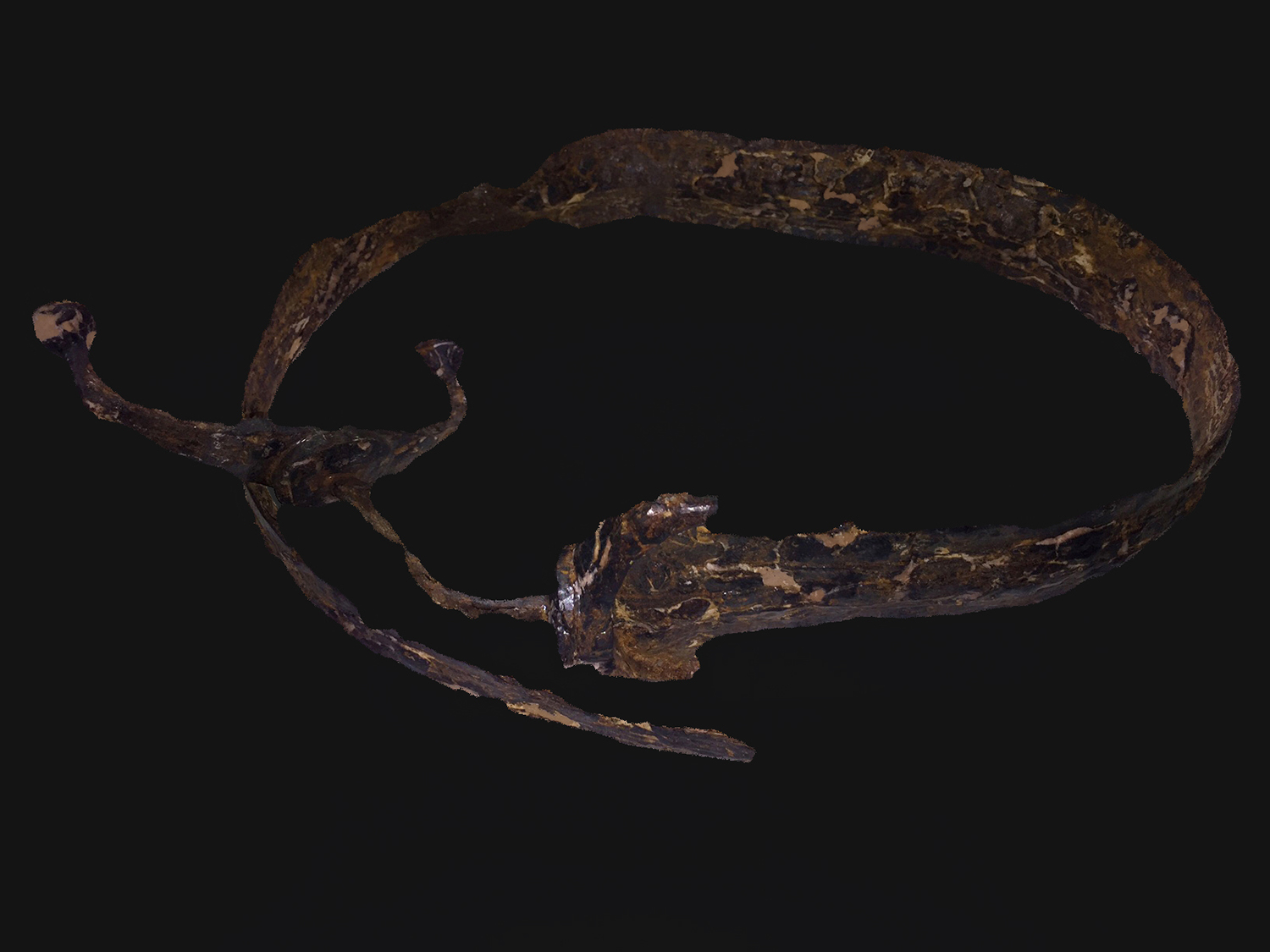
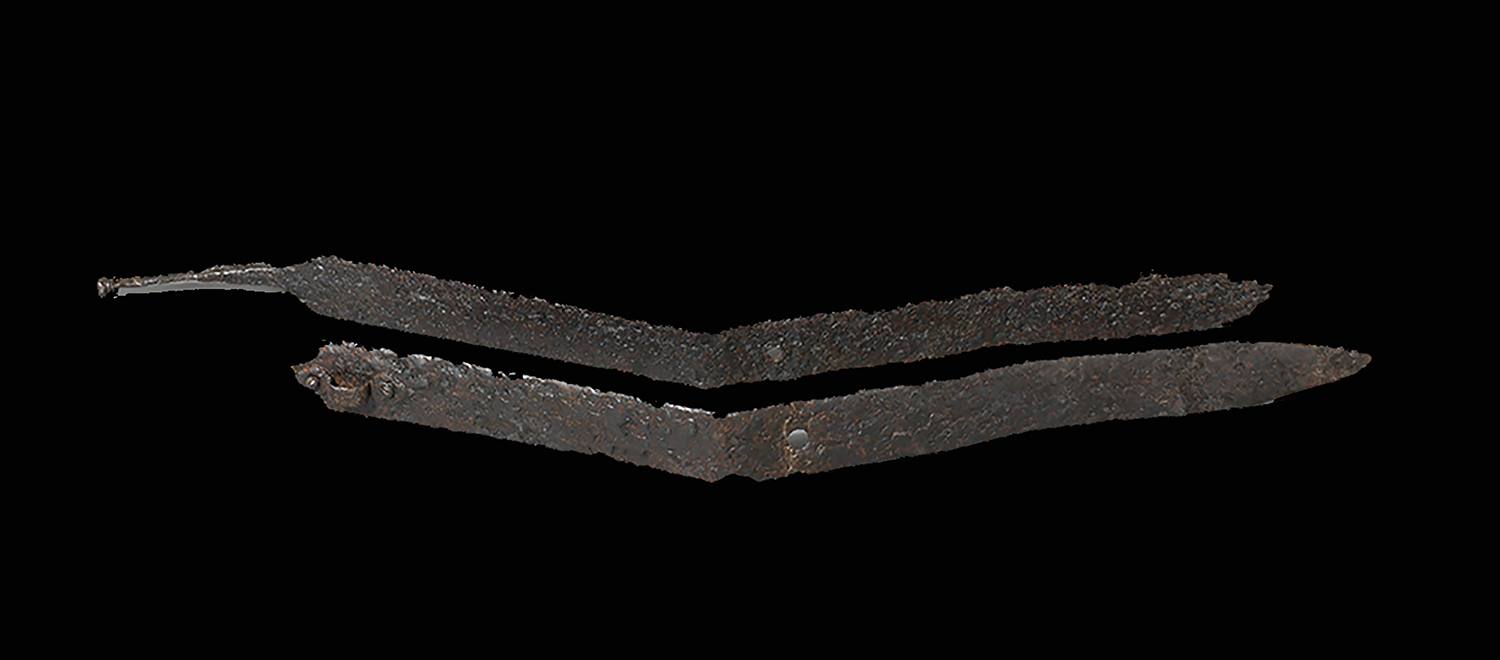
The sword with scabbard we present here (only the dorsal side is preserved) is of the La Tène type that was commonly used by the Iberians in our region. It is bent in half with the tang also bent. It has a carefully made hole that goes through the blade and scabbard and allowed it to be displayed by nailing it to a wall or a pole, etc.
It was discovered in a street in the settlement of Mas Castellar (Pontós, Alt Empordà) and dates to between the 3rd and 2nd centuries BC. It was found in front of a house that has been attributed to worship functions. In one of the rooms of the house, another sword was found associated with a human jaw.
In the world of the Indiketes, pierced swords were often associated with embedded skulls or parts of skulls, possibly exhibited as war trophies: the skulls and weapons of the defeated enemy. Weapons and skulls are also found in southern Gaul and in the Celtic world, further north. Classical sources speak of displays of severed heads.
But the question is more complex than that. Some of the skulls belong to children or adolescents and women or men of advanced age or with pathologies, who were unlikely to have been warriors. Beyond the display of trophies won from the enemy, other reasons must be considered. The debate remains open.