Terracotta
3rd c. BC
Mas Castellar (Pontós - Alt Empordà)
Sometimes the attribution of a certain object to a specific function leads to debate among experts. Debates that, in the absence of new contributions, often go on forever and never reach any consensus between the various opinions. The object we present today is one such case.
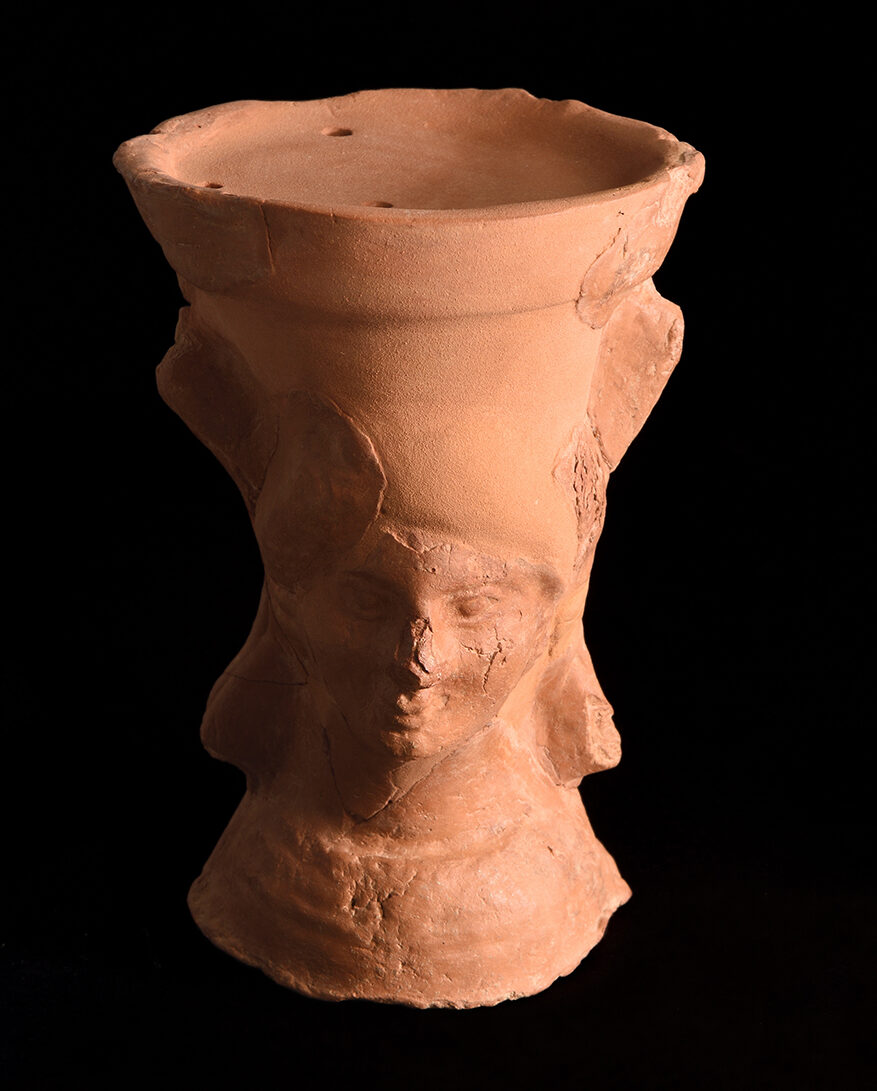
It is a terracotta figure, hollow inside, in the shape of the bust of a woman covered with a kalathos. The general consensus is that it represents Demeter, the Greek goddess protector of agriculture, although it is sometimes considered to be her daughter, Core. It was found in a silo at Mas Castellar in Pontós (Alt Empordà). Dating from between the 3rd and 2nd centuries BC, it is about 15 cm tall and made from two (vertical) moulds. The “lid” of the kalathos, when preserved, has one or several holes, usually five or seven.
These objects are widely distributed. They are found in Carthage, Sardinia and Ibiza, all along the Mediterranean coast of the Iberian Peninsula and as far north as Languedoc. The contexts vary: silos, necropolises, votive deposits, etc.
They are traditionally thought to have been incense or perfume burners (thymiateria), but none of those identified in Catalonia and the Valencian region show signs of burning, as with those from Carthage or Sardinia, for example. This has led to another interpretation. Still linked to the cult of Demeter, they are suggested to have been vessels intended to present the first fruits of the harvest (kernos). Ears of wheat would have been inserted into the hole or holes at the top. There is a mural painting from the Roman period that depicts Demeter with a kalathos and protruding ears of wheat. However, this interpretation has not been particularly well received.
Thus, the debate remains open: thymiaterion, kernos or what?