Bronze
1st-2nd c. AD
Empúries (L’Escala – Alt Empordà)
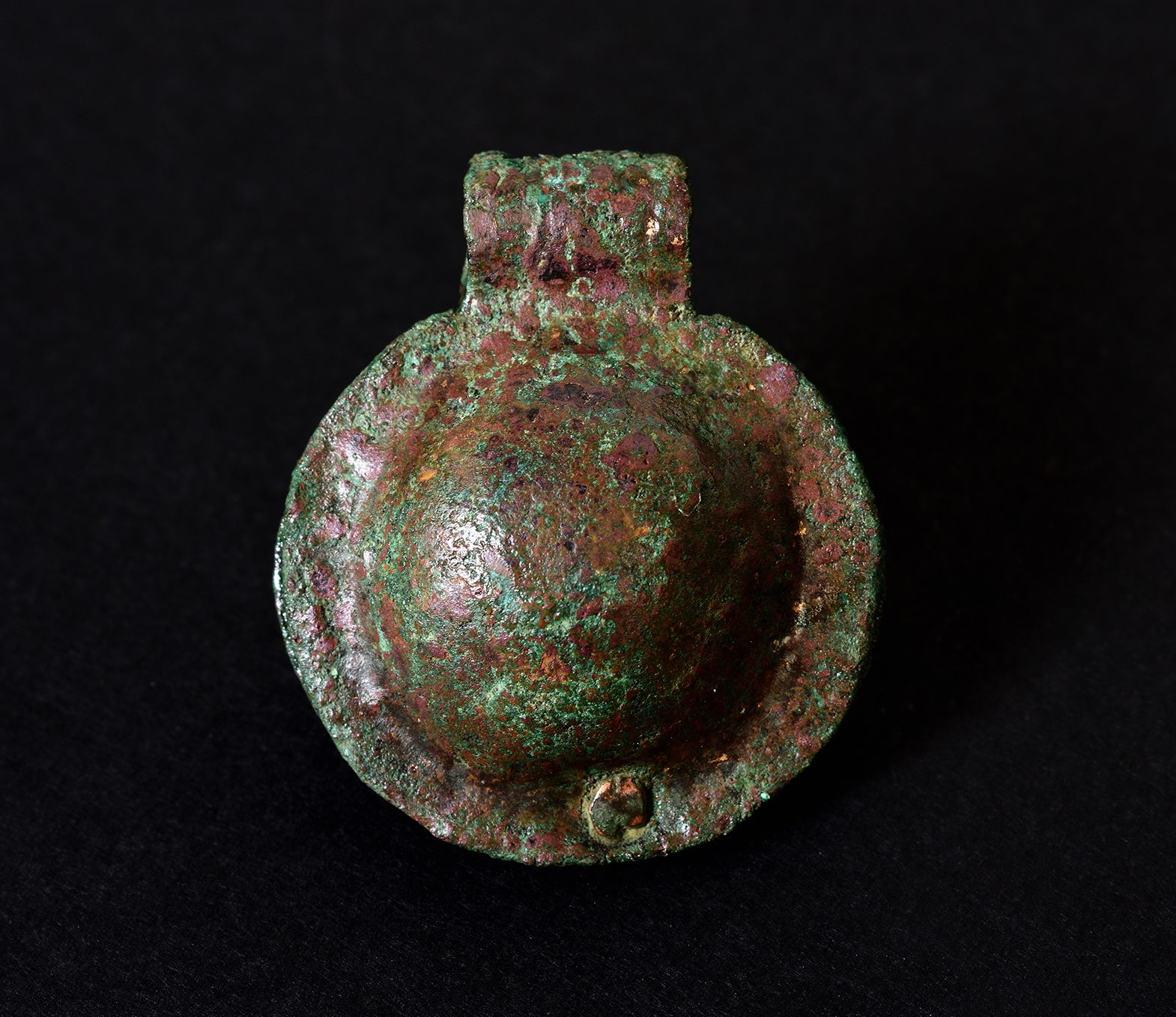
Eight days after birth, in addition to their name, free-born Roman boys received from their father a bulla. This was a pendant made up of two concave metal plates joined at the edges, which was generally worn around the neck. Depending on the social or economic status of the family, they would be made of gold, silver, bronze and even leather or a simple knot on a cord. Symbols of childhood and protective amulets, these bullae accompanied boys until they reached adulthood. An item of clothing also typical of free-born boys was the toga praetexta; it was white with a purple trim around the edge, like the toga of the magistrates.
For free-born boys, the transition from childhood to adulthood, and consequently to public life, took place around the age of 16. It was symbolised by a ritual consisting of, among other rites, taking off the bulla and offering it up in the family lararium (household shrine), along with toys. The toga praetexta was replaced with the toga virilis; this was completely white and was also known as libera or pura. This ritual took place on March 16, the day of the Liberalia, a festival dedicated to Bacchus.
The boy left childhood behind to become an adult, a Roman citizen, already capable of dedicating himself to the civic and military duties that fell to the lot of a citizen.
The bullae we present here come from Empúries. They are made of bronze and, lacking context, can be dated to between the 1st and 2nd centuries AD. Obtained from the plundering of one of the town’s Roman necropolises, they tell us that the children to whom they belonged did not reach adulthood. When they died, they were cremated and their bullae accompanied them to the grave. These two Emporitan children did not reach adulthood.